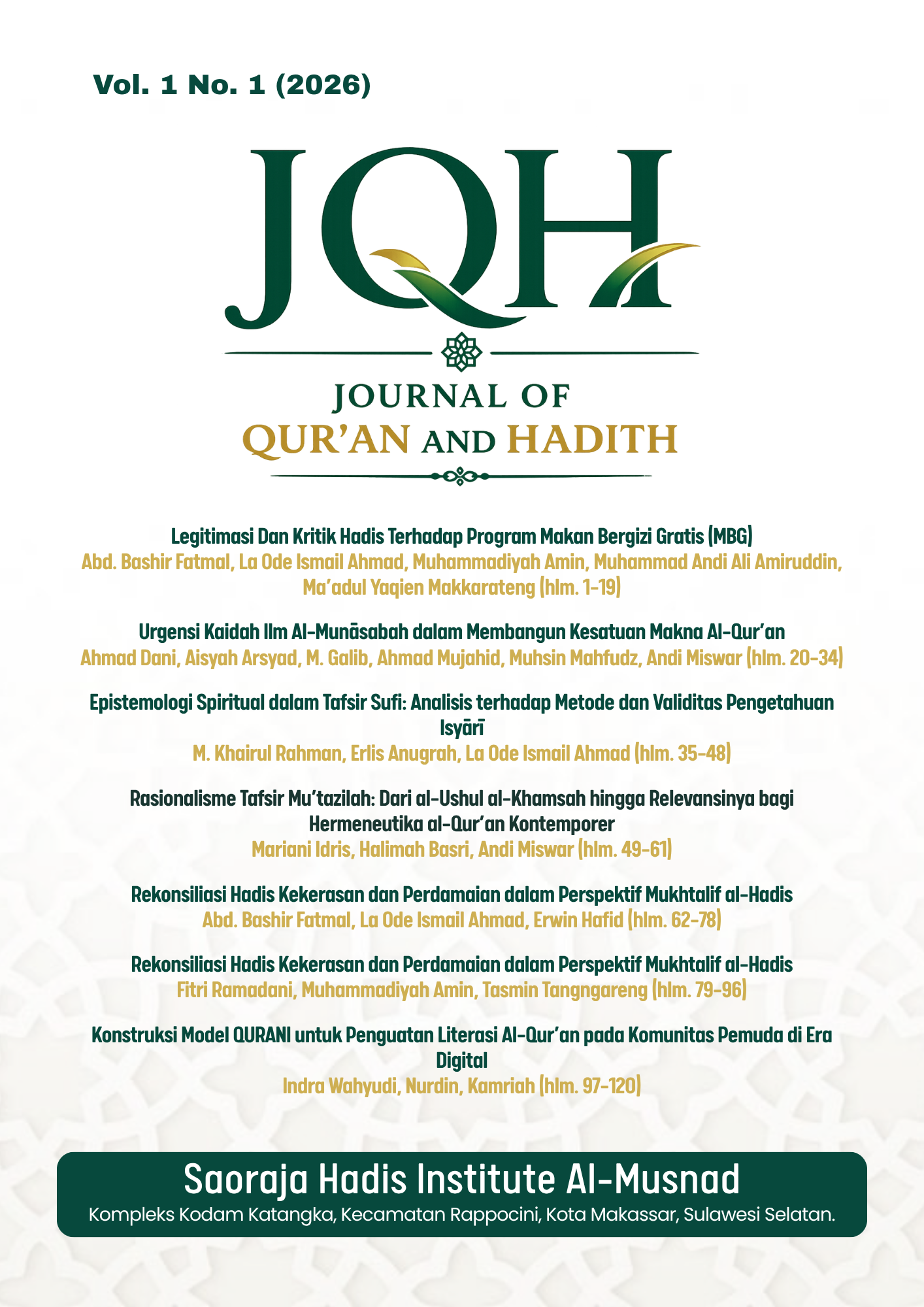
Legitimasi dan Kritik Hadis terhadap Program Makan Bergizi Gratis (MBG)
Keywords:
Hadith, Free Nutritious Meals Program, Maqāṣid al-Sharī’ah, Ith’ām al-Ṭa’ām, Public Trust (Amānah)Abstract
The Free Nutritious Meals Program (MBG) is a strategic policy of the Indonesian government designed to improve the nutritional status of the population, particularly schoolchildren and other vulnerable groups. Despite its significant social objectives, its normative legitimacy and ethical implementation from the perspective of hadith have not been comprehensively examined. This study aims to analyze the legitimacy and critical evaluation of the MBG Program through the framework of maqāṣid al-sharī’ah. It employs a qualitative library research method using a normative approach and thematic (mawḍū’ī) analysis of hadiths concerning food provision, leadership, trustworthiness, justice, and the prohibition of causing harm. The findings demonstrate that the MBG Program possesses strong normative legitimacy through hadiths emphasizing the virtue of iṭ’ām al-ṭa’ām (feeding others), the responsibility of leaders, and the protection of vulnerable groups. From the perspective of maqāṣid al-sharī’ah, the program contributes to the realization of ḥifẓ al-nafs, ḥifẓ al-’aql, ḥifẓ al-nasl, and supports ḥifẓ al-māl through accountable public financial management. Nevertheless, hadith also provides critical parameters by emphasizing the obligation to uphold trust (amānah), prevent ghulūl (misappropriation of public property), implement the principle of lā ḍarar wa lā ḍirār (no harm and no reciprocating harm), ensure distributive justice, and maintain transparency and accountability in governance. Overall, the MBG Program aligns with prophetic values when implemented transparently, fairly, professionally, sustainably, and consistently, thereby strengthening public welfare, social solidarity, ethical governance, national resilience, and long-term human development while reinforcing accountability, policy effectiveness, inclusive participation, institutional integrity, equitable access, and intergenerational social justice across Indonesia.
Downloads
Downloads
Published
Issue
Section
License
Copyright (c) 2026 Abd. Bashir Fatmal, La Ode Ismail Ahmad, Muhammadiyah Amin, Arifuddin Ahmad, Muhammad Andi Ali Amiruddin, Ma’adul Yaqien Makkarateng (Author)

This work is licensed under a Creative Commons Attribution-NonCommercial-ShareAlike 4.0 International License.